Laser Tattoo Removal: Sessions, Colours and Aftercare
How many laser tattoo removal sessions you are likely to need, which ink colours fade fastest and slowest, and how to look after your skin between sessions.
 Magdalena Wasiewicz7 min read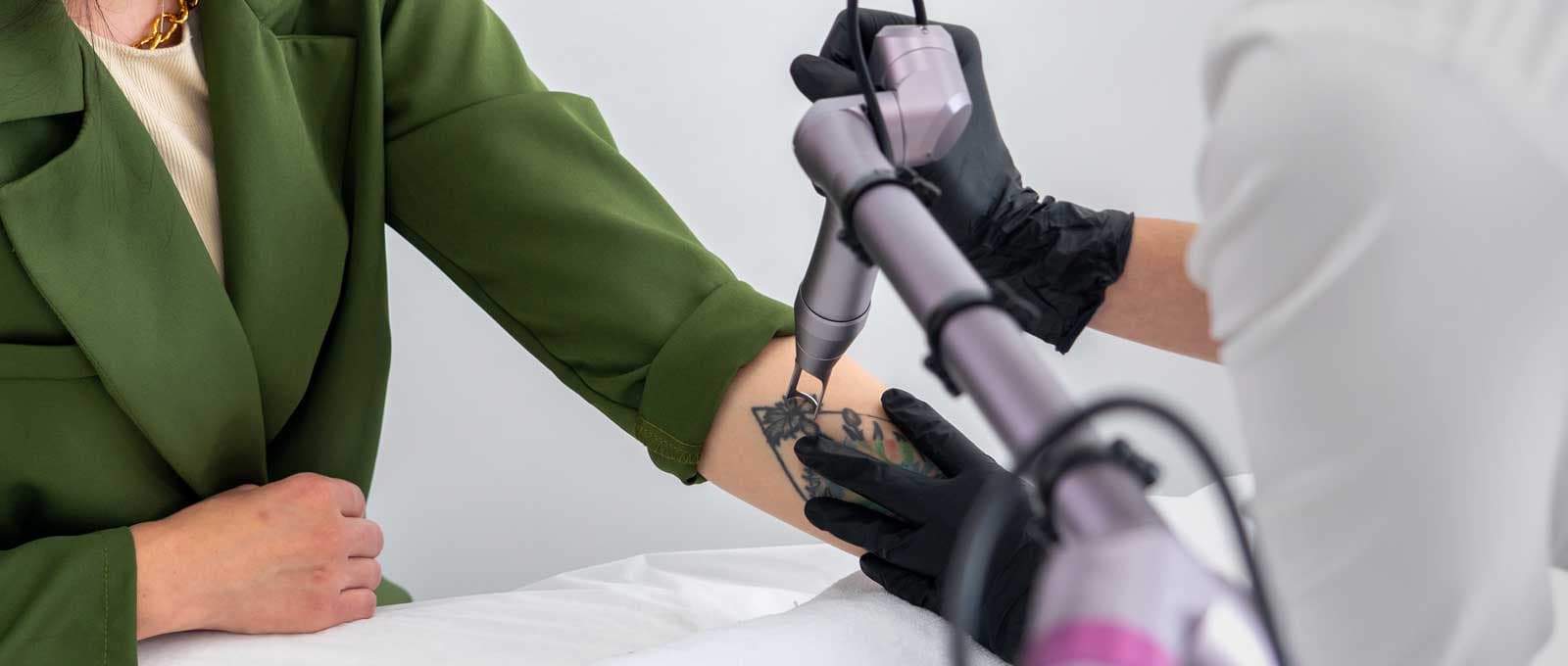
Most professional tattoos need somewhere between six and twelve laser sessions, spaced at least six to eight weeks apart, although some need more and complete clearance is not always possible. Black and dark blue inks usually respond best; yellow, white, pastel and skin-tone inks are hardest, and some light or cosmetic inks can darken.
How does laser tattoo removal work?
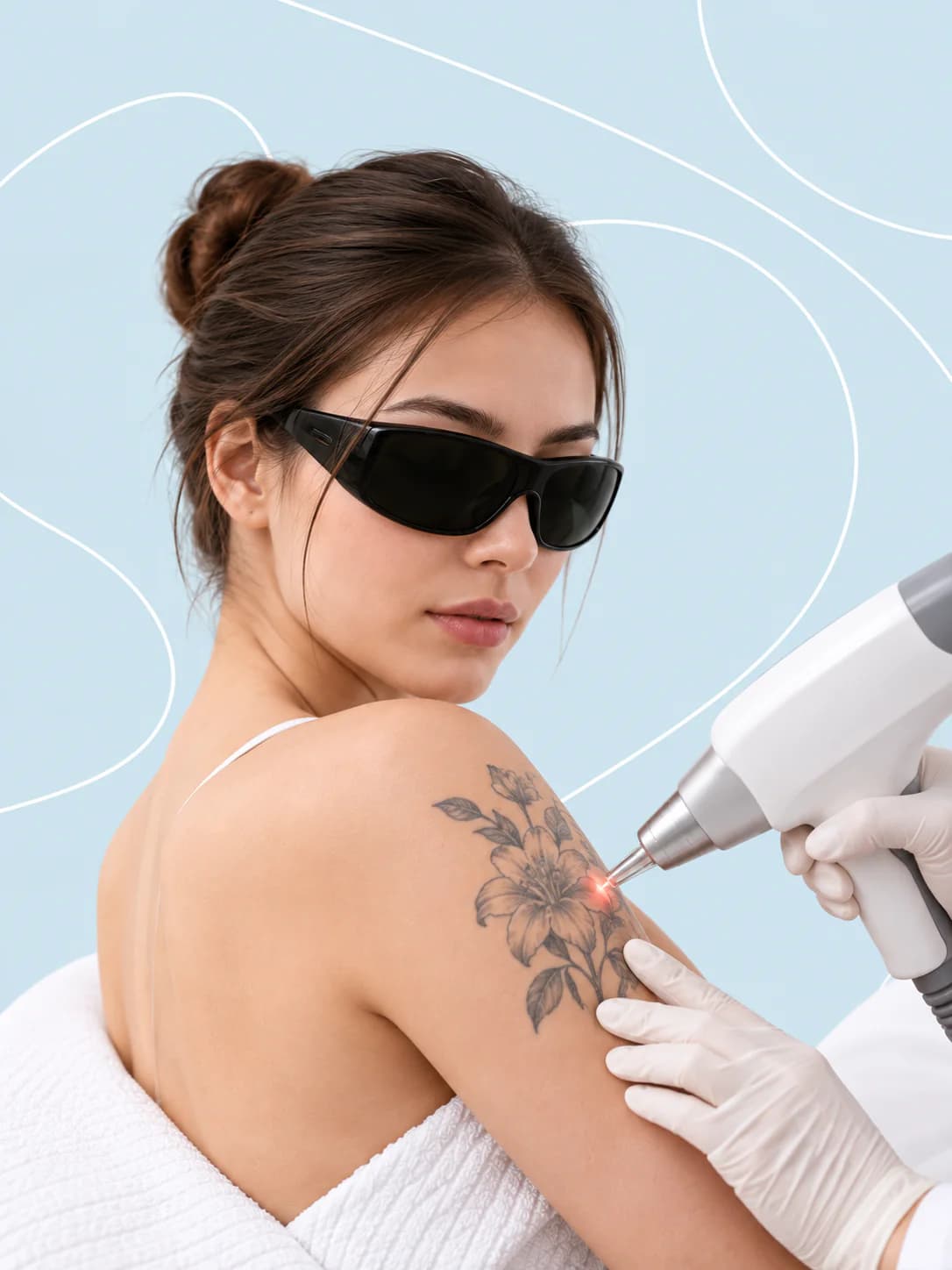
Tattoo ink sits in the dermis, the layer of skin beneath the surface, as particles too large for your immune system to clear. Laser tattoo removal uses very short, high-intensity pulses of light that the ink absorbs. The particles heat up and shatter into much smaller fragments, a process known as photothermolysis.
Once the ink is broken down, your body does the rest. Immune cells called macrophages engulf the fragments and carry them away through the lymphatic system. This clearing continues for weeks after each appointment, which is why a tattoo keeps fading between sessions and why sessions are spaced well apart: the skin needs time to heal and the body needs time to remove the ink.
Different colours absorb different wavelengths of light. Black absorbs all laser wavelengths, which makes it the easiest to treat, while other colours only respond to specific wavelengths. Part of your consultation is working out how the colours in your tattoo are likely to respond to the treatment we offer, so you know what to expect before you start.
How many sessions does laser tattoo removal take?
Nobody can tell you an exact number at your first visit, and you should be wary of anyone who does. What we can give you is a realistic range based on the tattoo in front of us. As a broad guide, amateur tattoos often fade in fewer sessions than professional ones, professional black tattoos commonly need somewhere around six to twelve, and dense, multicoloured pieces can need more.
Some practitioners use a scoring system such as the Kirby-Desai scale, which adds up points for skin type, location, colours, amount of ink, scarring and layering to estimate a likely number of sessions. It is a useful starting point, not a promise, and your plan is adjusted as we see how your tattoo responds.
What affects the number of sessions?
| Factor | Tends to fade faster | Tends to fade slower |
|---|---|---|
| Type of tattoo | Amateur or home-made, with less ink | Professional, densely saturated ink |
| Colour | Black and dark blue | Multicoloured, green, yellow, white or skin-tone |
| Age | Older tattoos that have already faded | Newer, crisp tattoos |
| Location | Closer to the heart, such as the upper arm, chest or neck | Further from the heart, such as hands, feet, ankles and lower legs |
| Layering | A single tattoo | Cover-ups and reworked tattoos with layers of ink |
| Skin | Lighter skin, which often allows stronger settings | Darker skin, which needs more conservative settings |
| Scarring and health | Smooth skin, good circulation, non-smoker | Existing scarring or raised ink; smoking has been associated with slower clearance |
Circulation matters because the lymphatic system does the clearing, so areas with a good blood and lymph supply tend to fade more quickly. Staying active, well hydrated and not smoking will not replace sessions, but they support the body’s natural clearing process.
Which tattoo colours are hardest to remove?
Colour is the single biggest factor after ink density. This is how different inks commonly respond, although individual inks vary a great deal because tattoo pigments are not standardised.
| Ink colour | How it usually responds | Worth knowing |
|---|---|---|
| Black | Most responsive | Absorbs all wavelengths; usually the best candidate for removal |
| Dark blue and navy | Usually responds well | Often fades alongside black |
| Red, dark orange and purple | Moderate | Often fades with more sessions; red inks are more commonly linked to allergic reactions |
| Green, turquoise and light blue | Slow | Can be stubborn and may need many sessions |
| Yellow and light orange | Hard | Absorb laser light poorly |
| White, pastel and skin-tone inks | Hardest | May darken after laser because of the pigments they contain; a test spot is essential |
A word of caution on semi-permanent make-up and microblading
Cosmetic tattoos such as microbladed brows and lip liner often use pigments containing iron oxide or titanium dioxide. These can react to laser energy by turning grey or black rather than fading. Areas close to the eyes also need particular care. If you want to remove semi-permanent make-up, we will assess it carefully, test a small spot first, and tell you honestly if we do not think laser is the right choice.
Should I fade my tattoo for a cover-up or remove it completely?
Many clients do not want a tattoo gone completely; they want it light enough for a tattoo artist to cover with something new. Fading for a cover-up usually takes noticeably fewer sessions than full removal, because the goal is to lighten dark lines and heavy areas rather than clear every trace of ink.
If a cover-up is your plan, speak to your tattoo artist early. They can tell you how light the old design needs to be, and we can aim for that. Allow the skin to heal fully after your last session before it is tattooed again; your artist will advise on timing.
What does laser tattoo removal feel like?
Clients often describe it as hot fat spitting on the skin or a series of quick elastic-band snaps. Each session is brief, so even larger tattoos are usually over in minutes. Cooling is used throughout to make it more comfortable, and a numbing cream may be used where appropriate.
Straight afterwards the tattoo usually turns white for a short time, a harmless reaction called frosting. Redness, swelling and tenderness are normal, and small pinpoint bleeding can happen. Over the following days blisters and scabs are common as the skin heals.
Laser tattoo removal aftercare
- Keep the area clean and dry, and pat it gently rather than rubbing.
- Apply the aftercare balm and dressing we advise, and follow the instructions you are given.
- Use a cool compress wrapped in a clean cloth to ease swelling.
- Do not pop blisters or pick at scabs; let them heal and fall away naturally.
- Avoid swimming pools, hot tubs, saunas and steam rooms until the skin has fully healed.
- Avoid hot baths and hard exercise for the first 24–48 hours.
- Keep the area out of the sun, and use SPF 50 once healed and throughout your course.
- Wear loose clothing over the area and avoid shaving over it until it has healed.
What are the risks and side effects?
Redness, swelling, blistering, scabbing and itching are expected and usually settle within one to two weeks. Less common risks include lighter patches (hypopigmentation) or darker patches (hyperpigmentation), which are more likely in darker or tanned skin and usually fade over months but can be long-lasting. Changes in skin texture or scarring are uncommon and more likely if blisters or scabs are picked. Rarely, an allergic reaction can occur as ink particles are released, particularly with some red inks.
It is also important to be realistic: some tattoos leave a faint shadow of ink, often called a ghost image, even after many sessions. If you notice signs of infection, such as increasing pain, heat, spreading redness, pus or a high temperature, contact us straight away; if you feel unwell out of hours, call NHS 111.
Who shouldn’t have laser tattoo removal?
- Anyone under 18.
- People who are pregnant or breastfeeding.
- Anyone with tanned skin, recent sunbed use or self-tan over the tattoo.
- Skin with an active infection, cold sore, open wound or broken skin in the area.
- People with a history of keloid scarring or poor wound healing.
- Anyone taking, or who has recently taken, medicines that increase light sensitivity or affect healing — tell us about all medication.
- Tattoos with a mole within them that has not been checked; we treat around it.
Book a free consultation and patch test
A free patch test is required before your first session. At our clinic at 17 Queen Street, Southwell, easy to reach from Newark-on-Trent, Mansfield and Nottingham, we will look at your tattoo’s colours, age and location, discuss your medical history and give you an honest estimate of the sessions you may need, including whether full removal is realistic. Session prices depend on the size of the tattoo and are listed in our price guide.
Read more about laser tattoo removal at Skin Anatomy, see our guide to laser hair removal sessions and skin types, or book your free consultation.
This article is general information, not medical advice. Individual results vary, and complete removal is not always possible. Treatments at Skin Anatomy are for adults aged 18 and over.
This article is general information, not personal medical advice. Treatments are for adults aged 18 and over, suitability is assessed at a consultation, and individual results vary. If you have a new or changing mole, or any skin symptom that worries you, please see your GP.
Book an Appointment
It's easy — and consultations are free.
Questions Answered
Can a tattoo be completely removed by laser?
How far apart should laser tattoo removal sessions be?
Does laser tattoo removal leave a scar?
Can laser remove microblading or semi-permanent make-up?
How many sessions does it take to fade a tattoo for a cover-up?
Magdalena Wasiewicz
Founder & Lead Aesthetic Practitioner
Founder of Skin Anatomy, fully qualified to the highest level in aesthetic practice and currently studying medicine.
Open Profile